

AI Insights · Timothy · April 2024
Top 5 Air Travel Apps on iOS in UAE Q1 2024
Discover the performance of the top 5 air travel apps on iOS in the United Arab Emirates during Q1 2024, including trends in downloads, revenue, and active users.
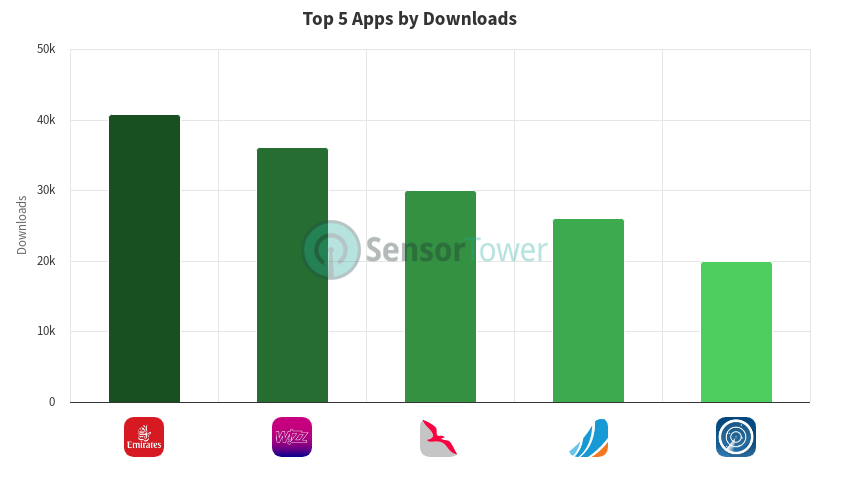
During the first quarter of 2024, the top air travel apps on the iOS platform in the United Arab Emirates saw varied performance in terms of downloads, active users, and revenue. Here is a breakdown of their metrics:
Emirates showed a consistent performance in weekly downloads, fluctuating between approximately 2.8K and 3.6K. The highest downloads were recorded at the start of January with 3.6K, while mid-February saw a dip to 2.8K. Weekly active users hovered around 6.7K to 7.3K, peaking in early January. However, there was a slight decline by the end of the quarter, stabilizing at around 6.9K.
Wizz Air - Book Flights experienced a gradual decrease in weekly downloads, starting from 3.6K in early January to around 2.3K by mid-March. Active users followed a similar pattern, starting at 8.3K and ending the quarter at approximately 7.3K. Despite the decline, there was a notable peak in mid-March with 2.8K downloads and 7.4K active users.
Air Arabia had a more stable trend in weekly downloads, averaging around 2.1K to 2.9K. The highest number of downloads was noted at the beginning of January with 2.9K. Active users showed some fluctuations but remained relatively stable, starting at 6.3K and peaking at 6.6K in early January before ending the quarter at 6.2K.
flydubai saw a steady performance with weekly downloads ranging from 1.8K to 2.3K. The highest downloads were observed in late February with 2.3K. Active users started at 4.2K in early January, peaked at 4.5K in late February, and ended the quarter at approximately 4.3K.
Flightradar24 | Flight Tracker had a consistent weekly revenue, peaking at $2.4K at the start of January and March. Downloads were relatively stable, starting at 1.8K and experiencing a slight dip to around 1.2K in mid-March. Active users fluctuated between 4.1K and 4.7K, with the highest number observed in early January.
These insights are based on data from Sensor Tower. For more detailed information and further insights, visit Sensor Tower.